
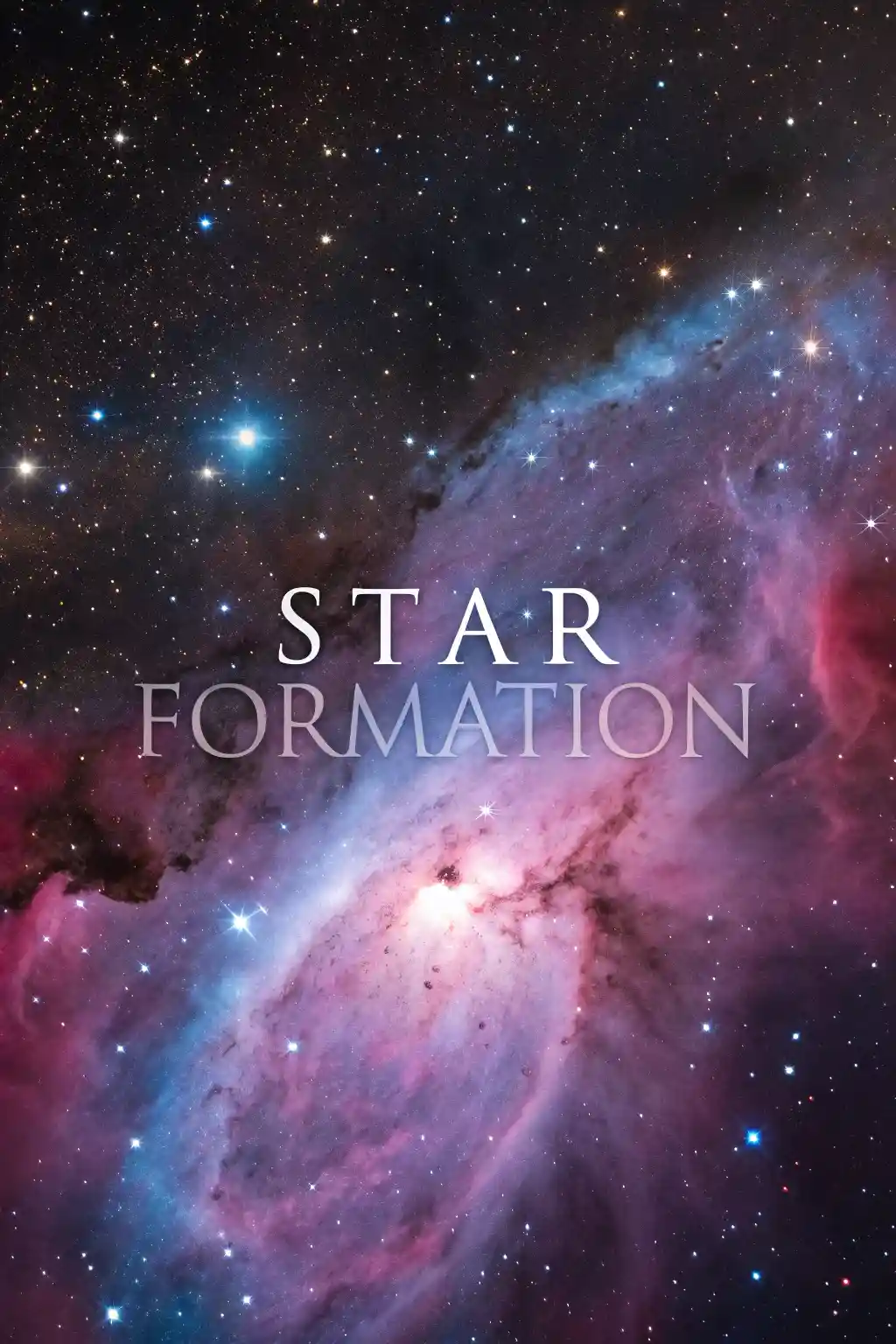
Stellar Beginnings: Unveiling Star Formation in the Distant Galaxies of the Early Universe
Original price was: $4.99.$2.99Current price is: $2.99.
Explore the mysteries of star formation in distant galaxies in this engaging book. Learn how stars and planets emerge, the role of galactic environments, and insights from space telescopes like JWST. A must-read for astronomy enthusiasts and space lovers!
Stellar Beginnings: Unveiling Star Formation in the Distant Galaxies of the Early Universe (E-Book Details)
The vastness of space holds countless mysteries, and among them, the process of star formation in distant galaxies remains one of the most intriguing. How do stars form in the early universe? What role do galactic environments play in shaping them? How do modern telescopes like the James Webb Space Telescope (JWST) help us uncover these cosmic processes?
This book, “Star Formation in Distant Galaxies”, takes you on a captivating journey into the heart of the universe, revealing the intricate processes that govern the birth of stars and planets. It is a guide for anyone fascinated by the cosmos—whether you’re an astronomy enthusiast, student, or space lover.
Understanding Star Formation: The Cosmic Origins of Light
How do stars form? Stars are born from vast clouds of gas and dust known as molecular clouds. These clouds, primarily composed of hydrogen, undergo gravitational collapse, leading to the formation of protostars. Over millions of years, nuclear fusion ignites in these infant stars, marking the beginning of their journey through cosmic time.
This book explains:
✅ The physics behind molecular cloud collapse and how temperature, pressure, and gravity influence star birth.
✅ The role of stellar nurseries, such as the Orion Nebula, in producing young, bright stars.
✅ How protostars transition into main-sequence stars like our Sun.
The Role of Galaxies in Star Formation
Galaxies are vast ecosystems where stars are born, live, and eventually die. The type of galaxy plays a crucial role in determining the rate and nature of star formation.
This book dives into:
📌 Spiral Galaxies: How their rotating arms provide the perfect environment for continuous star formation.
📌 Elliptical Galaxies: Why they contain old stars but little new star formation.
📌 Irregular Galaxies: Their chaotic structures and unique star-forming regions.
Did you know? Some galaxies can produce thousands of stars simultaneously in events known as starbursts—a phenomenon often triggered by galactic collisions.
How Do We Study Star Formation in Distant Galaxies?
Since the light from distant galaxies takes billions of years to reach us, studying them is like looking back in time. Advanced space telescopes allow us to observe these ancient cosmic events.
🔭 James Webb Space Telescope (JWST): JWST’s infrared vision helps detect newborn stars hidden in clouds of dust.
🔭 Hubble Space Telescope (HST): Provides stunning images of star-forming regions in nearby galaxies.
🔭 ALMA Observatory: A powerful radio telescope used to study cold molecular gas—the raw material for star formation.
Real Observations: Discover how astronomers use these instruments to uncover star formation rates, stellar lifecycles, and planetary system formation in distant galaxies.
The First Stars and Galaxies: Exploring the Early Universe
The first stars, known as Population III stars, formed just a few hundred million years after the Big Bang. These stars were massive, short-lived, and responsible for enriching the universe with heavy elements.
🚀 This book explores:
🔹 How the first galaxies emerged and rapidly formed stars.
🔹 The impact of cosmic reionization, which transformed the early universe.
🔹 How modern telescopes are detecting the faint signals of these early stars.
Understanding early star formation is key to piecing together the origin of galaxies like the Milky Way and the potential for life elsewhere in the universe.
Galactic Collisions and Starbursts: Cosmic Fireworks
Galaxies are not static—they collide, merge, and interact, creating spectacular bursts of star formation. Some of the most extreme environments for stellar birth occur in these collision-induced starbursts.
🔥 Notable examples:
🌟 The Antennae Galaxies – Two merging galaxies producing thousands of new stars.
🌟 The Milky Way & Andromeda Collision – A future event that will reshape our galactic neighborhood.
Starbursts influence not just galaxies but also the formation of exoplanets—the planets orbiting stars outside our solar system.
The Influence of Supermassive Black Holes on Star Formation
At the heart of most galaxies lies a supermassive black hole (SMBH), millions to billions of times the mass of the Sun. These cosmic giants can both hinder and enhance star formation.
🔹 Negative Feedback: Powerful jets and radiation from SMBHs can heat surrounding gas, preventing it from collapsing into new stars.
🔹 Positive Feedback: In some cases, SMBH activity compresses gas clouds, triggering starbursts.
Fascinating Fact: The Milky Way’s central black hole, Sagittarius A*, has had periods of intense activity that may have shaped star formation in our galaxy.
How Does Star Formation Lead to Planetary Systems?
The same clouds that birth stars also give rise to planets, moons, and asteroids. Protoplanetary disks—rotating disks of gas and dust around young stars—are the building blocks of solar systems.
🌎 Topics covered:
✅ The role of circumstellar disks in forming planets.
✅ The discovery of exoplanets in star-forming regions.
✅ How conditions in distant galaxies might support habitable worlds.
Studying planet formation in distant galaxies helps us understand how common Earth-like planets might be across the cosmos.
The Future of Star Formation Studies
With cutting-edge technology, we are entering a golden age of astronomy. The future holds exciting possibilities for discovering new stars, planets, and even signs of life in other galaxies.
🚀 Upcoming Missions & Observatories:
🔹 Extremely Large Telescope (ELT): Will provide an unmatched view of distant galaxies.
🔹 Nancy Grace Roman Space Telescope: Designed to study exoplanets and star formation.
🔹 Next-Generation Space Observatories: Future telescopes may allow us to directly image young planetary systems in the making.
The universe is vast and full of wonders—and the best discoveries are yet to come.
Why You Should Read This Book
📌 Easy to understand: No complex jargon—just fascinating space science!
📌 Latest discoveries: Based on real observations from JWST, Hubble, and ALMA.
📌 A journey through time: Learn how stars formed from the Big Bang to the present.
📌 Perfect for all levels: Whether you’re an amateur stargazer or an aspiring astrophysicist, this book will deepen your knowledge.
🚀 Get ready to embark on an incredible journey into the birth of stars and the evolution of galaxies!
Follow The Author On Youtube
For Any Queries Visit Contact Us Page
Only logged in customers who have purchased this product may leave a review.
Vendor Information
- Store Name: Vellanox
- Vendor: Vellanox
- No ratings found yet!
When the Giants Aligned: The Great Conjunction of Jupiter and Saturn (2020) and Its Global Fascination

Red Planet Revelations: Insights from Perseverance and InSight on Mars

Cryovolcanism: The Hidden Icy Eruptions of Europa and Beyond

Phantom Galaxy Unveiled: Infrared Wonders of the Cosmos

Parker Solar Probe: A New Era in Sun Exploration

Beyond Earth Unlocking the Secrets of Microbial Life in Extreme Environments

Related products

Breakthrough Listen and the New Frontier of the Search for Extraterrestrial Intelligence

Comet NEOWISE: A Historic Encounter That Captivated the World

Enceladus and Titan: Unveiling the Secrets of Saturn’s Habitable Moons

Magnetic Giants of the Cosmos: Decoding Neutron Stars, Magnetars, and the Mysterious VT 1137-0337
Parker Solar Probe: A New Era in Sun Exploration
Red Planet Revelations: Insights from Perseverance and InSight on Mars

Satellites Above, Stars Below: The Rise of Low-Earth Orbit and Light Pollution
Reviews
There are no reviews yet.