
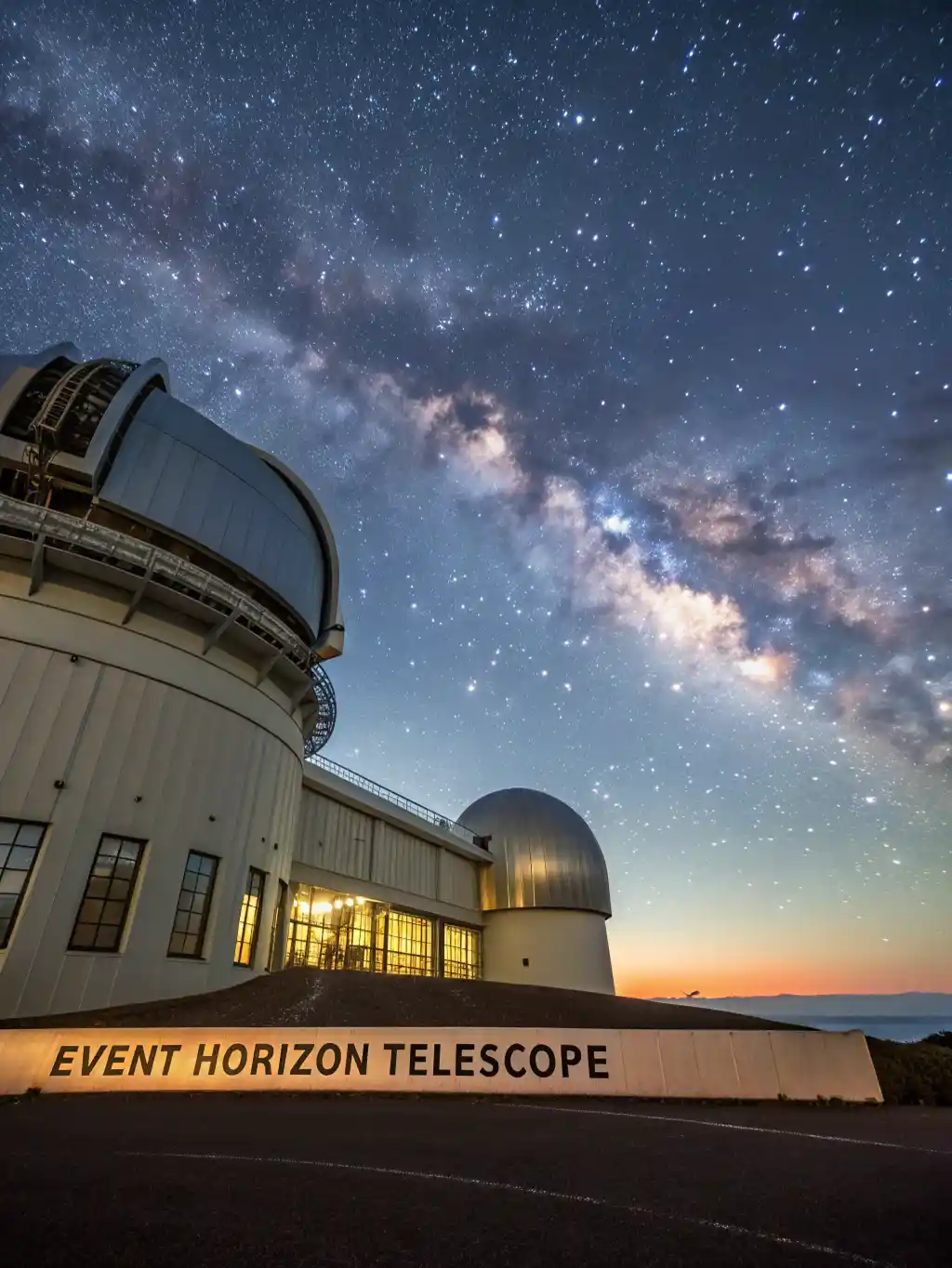
Unveiling the Shadows: The Event Horizon Telescope’s Quest to Image Black Holes
Original price was: $4.99.$2.99Current price is: $2.99.
Explore the groundbreaking research behind the Event Horizon Telescope (EHT) and the first image of a black hole. Learn how scientists captured this cosmic wonder and what it means for the future of astrophysics in this exciting eBook.
Unveiling the Shadows: The Event Horizon Telescope’s Quest to Image Black Holes (E-Book Details)
The universe is a vast and mysterious expanse filled with cosmic wonders that have intrigued scientists and astronomers for centuries. Among these wonders, black holes stand out as some of the most enigmatic and powerful objects in existence. Their ability to warp space and time has led to endless questions about the fundamental nature of reality.
For years, black holes remained purely theoretical—predicted by Albert Einstein’s General Theory of Relativity but never observed directly. However, with rapid advancements in astronomical technology, the scientific community embarked on an ambitious quest to capture the first-ever image of a black hole. The Event Horizon Telescope (EHT) made this possible, revolutionizing our understanding of these celestial giants.
This eBook takes you on an extraordinary journey into the depths of black hole research, exploring how the EHT works, the process of imaging black holes, and the profound implications of these discoveries for physics and astronomy.
Introduction to Black Holes
What Are Black Holes?
Black holes are regions of space where gravity is so strong that nothing—not even light—can escape their pull. This point of no return is called the event horizon. Once an object crosses this boundary, it is forever trapped.
Scientists categorize black holes into three main types:
- Stellar Black Holes – Formed from the collapse of massive stars.
- Supermassive Black Holes – Found at the centers of galaxies, including the Milky Way’s own Sagittarius A*.
- Intermediate Black Holes – Theoretically exist between stellar and supermassive black holes but remain largely unconfirmed.
For decades, black holes remained unseen, detected only by their influence on nearby objects. That changed in 2019 when the Event Horizon Telescope captured the first direct image of a black hole in the galaxy M87.
The Event Horizon Telescope: How It Works
A Global Collaboration
The Event Horizon Telescope (EHT) is not a single telescope but a network of radio observatories spread across the world. By using Very Long Baseline Interferometry (VLBI), the EHT combines data from different locations, effectively creating a telescope the size of the Earth.
The observatories that contributed to the first black hole image included:
- ALMA (Chile)
- IRAM 30-meter Telescope (Spain)
- James Clerk Maxwell Telescope (Hawaii, USA)
- South Pole Telescope (Antarctica)
- APEX (Atacama, Chile)
This international effort involved over 200 scientists and engineers working together to collect and process massive amounts of data.
Imaging the Unseeable
Because black holes do not emit light, traditional telescopes cannot capture them directly. Instead, the EHT focuses on the shadow of a black hole, created by its powerful gravitational pull bending surrounding light.
The process of imaging a black hole involves:
- Capturing radio waves from space
- Synchronizing multiple telescopes worldwide
- Processing petabytes of data using supercomputers
- Reconstructing an image through complex algorithms
The final result was a historic image of the supermassive black hole at the center of M87, revealing a glowing orange ring around a dark core.
Scientific Breakthroughs from Black Hole Imaging
Testing Einstein’s General Relativity
Einstein’s Theory of General Relativity, published in 1915, predicted the existence of black holes. The EHT’s observations provided the first direct test of these predictions on a supermassive scale.
The results confirmed that the black hole’s shadow matched theoretical models, strengthening confidence in Einstein’s equations.
Unraveling the Mysteries of Accretion Disks
The bright ring seen in the black hole image is caused by hot gas swirling around the event horizon, known as an accretion disk. The EHT’s data allowed scientists to analyze how material falls into black holes and the role of magnetic fields in shaping these cosmic behemoths.
Understanding Galactic Evolution
Supermassive black holes, such as the one in M87, influence their host galaxies by releasing jets of high-energy particles. Studying these black holes helps scientists understand how galaxies evolve over billions of years.
The Future of Black Hole Research
Next-Generation Event Horizon Telescope (ngEHT)
The first black hole image was just the beginning. Scientists are now developing the next-generation Event Horizon Telescope (ngEHT), which will feature more observatories and higher-resolution imaging.
Future goals include:
- Capturing real-time videos of black hole activity
- Mapping magnetic fields in detail
- Exploring the effects of quantum gravity at the event horizon
Imaging Sagittarius A*
The next major target for the EHT is Sagittarius A*, the black hole at the center of our Milky Way. While smaller than M87’s black hole, Sagittarius A* is much closer, offering a unique opportunity to study black hole dynamics in greater detail.
Why This Book Matters
This book is perfect for anyone fascinated by black holes, astronomy, and the frontiers of science. Whether you’re a beginner or someone with a scientific background, you will find this an engaging, insightful read.
Key Takeaways from This Book:
✔️ The groundbreaking discovery of the first black hole image
✔️ How the Event Horizon Telescope works
✔️ The role of black holes in shaping galaxies
✔️ The latest advancements in astrophysics and radio astronomy
✔️ What future research holds for black hole studies
Who Should Read This Book?
🔹 Astronomy Enthusiasts – Gain a deeper understanding of black hole imaging.
🔹 Students & Educators – A valuable resource for learning and teaching astrophysics.
🔹 Space Lovers – Anyone who marvels at the mysteries of the cosmos.
Final Thoughts
Black holes are gateways to the unknown, challenging our understanding of physics and the universe itself. The Event Horizon Telescope represents a historic milestone in space science, proving that human curiosity and innovation know no bounds.
The future of black hole research is bright, and as technology advances, we may soon uncover even more secrets hidden within the depths of space-time.
Get your copy today and journey into the heart of the universe’s greatest mystery!
Follow The Author On Youtube
For Any Queries Visit Contact Us Page
Only logged in customers who have purchased this product may leave a review.
Vendor Information
- Store Name: Vellanox
- Vendor: Vellanox
- No ratings found yet!

Comet NEOWISE: A Historic Encounter That Captivated the World

Enceladus and Titan: Unveiling the Secrets of Saturn’s Habitable Moons

Voyage to the Ice Giants: NASA’s Bold Mission to Unveil the Secrets of Uranus

Breakthrough Listen and the New Frontier of the Search for Extraterrestrial Intelligence

Beyond Earth Unlocking the Secrets of Microbial Life in Extreme Environments
When the Giants Aligned: The Great Conjunction of Jupiter and Saturn (2020) and Its Global Fascination

Related products

Artemis Rising: The Next Frontier of Lunar Colonization

Beyond Pluto Unveiling the Secrets of the Kuiper Belt with New Horizons
Enceladus and Titan: Unveiling the Secrets of Saturn’s Habitable Moons

Field Work and Report Writing By Dr. Krishnanand

Magnetic Giants of the Cosmos: Decoding Neutron Stars, Magnetars, and the Mysterious VT 1137-0337

Mars Bound: Unveiling SpaceX and NASA’s Plans for the First Human Settlement

Phantom Galaxy Unveiled: Infrared Wonders of the Cosmos
Reviews
There are no reviews yet.